 Add to Home Screen
Faces blended, parents scammed, shopping steered: AI is being turned against ordinary people. 3 ways to protect your family
Scrolling the trending topics these past few days, you may have felt an uneasiness that's hard to name: AI seems less and less to be helping you, and more and more to be “working against” you.

Contents
Scrolling the trending topics these past few days, you may have felt an uneasiness that’s hard to name: AI seems less and less to be helping you, and more and more to be “working against” you.

A celebrity’s face gets “blended” into an AI short film. AI-generated fake faces have been shown by research to fool older people more easily. You ask AI to help you pick something to buy, and the price it quotes doesn’t match the product page, while the recommended slots can be bought.
These three stories each target one of the things ordinary people care about most: your face, your parents’ money, and your shopping cart. We’ll walk through them one by one, then give you 3 ways to protect your whole family.
1. Your face: even celebrities are fighting back. What about everyone else?

On 21 November, “Peng Yuchang (彭昱畅) face-blended by AI” shot to the top of Weibo’s trending list. In an AI short film about careers such as nursing, accounting and law, the intern at the end who calls himself the “scapegoat” looked remarkably like Peng Yuchang: his features, his expressions, even his voice. That evening, his studio issued a formal statement: he had never authorised anyone to use his likeness or facial data for AI training, face blending or distribution, and lawyers had been instructed to notarise the evidence.
He isn’t the first. Before him, the studios of actors such as Song Weilong (宋威龙) and Zhao Liying (赵丽颖) had also issued statements defending their rights over AI face blending.
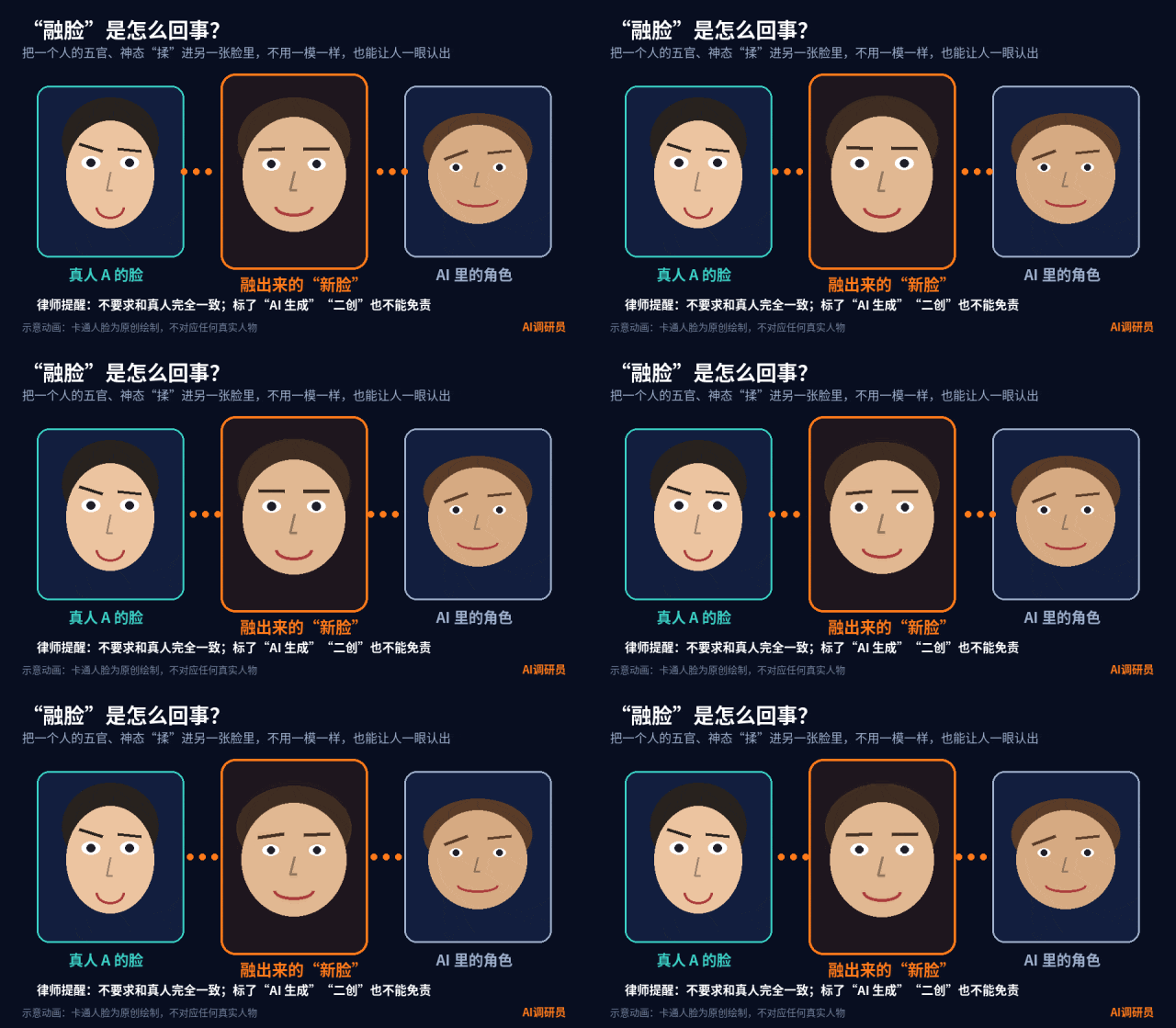
What does “face blending” mean? It isn’t simply pasting A’s face onto B. It kneads one person’s features and expressions into an AI character. The result isn’t necessarily identical, but you can tell at a glance who it is. Lawyers point out that infringement doesn’t require an exact match with the real person, and labelling something “AI-generated” or “personal fan remix” is no shield against liability.
Celebrities have studios and lawyers. What about ordinary people? The front-facing photos and voice clips you post on WeChat Moments or short-video apps could just as easily be taken and “blended”. This year, one company used AI, without authorisation, to impersonate a well-known economist in product-promotion videos aimed squarely at older people who trust experts. Market regulators published it as a typical case.
2. Your parents’ money: AI fake faces look “nicer” than real ones

This one hurts more than you might think. In a new study from the University of Florida, 126 people aged 18 to 89 had their brains scanned while judging whether 80 faces were real or fake; half of the faces were AI-generated. The result: young or old, people found the AI fake faces more “real” than the real photos. The researchers call this the “deepfake hyperrealism” effect, and the bias was stronger in older people.
The reason lies in the brain. The anterior insula, which is in charge of “sounding the alarm”, was noticeably less active when people looked at AI faces. AI faces are averaged from huge numbers of real faces, so they’re more symmetrical and more “standard”, and that actually makes them feel familiar and friendly.
Scammers have been using this for a while. In mid-November, police broke up an AI antique-appraisal fraud ring. It posted AI videos on short-video platforms claiming to buy old coins and calligraphy and paintings at high prices, then pulled older people into private livestream rooms. The hosts posed as museum curators, charged appraisal fees and deposits, and even adopted victims as “Mum” and “Dad” to play on their emotions. More than 10 million yuan was involved, and most of the over 1,000 victims were elderly.
Even more direct is the “grandson calling” scam. One elderly person got a video call from their “grandson”. The face and voice both matched, and he asked straight away for 50,000 yuan to tide him over. Luckily a bank employee noticed something was off and called the real grandson to check: he had never asked for any money. According to the Ministry of Public Security, in the first quarter of 2025, AI face-swap and voice-cloning fraud cases nationwide jumped 45% quarter on quarter, and older people made up as much as 38% of the victims.
3. Your shopping cart: an AI shopping assistant isn’t necessarily on your side

During this year’s Singles’ Day (Double 11) sales, almost every platform rolled out an AI shopping assistant. Yet according to a survey compiled by SMZDM (什么值得买), 84.56% of people had tried AI shopping, but only 16.06% felt it picked accurately.

There are three main pitfalls. First, the prices don’t match: in one hands-on test, the AI gave a post-coupon price of 144 yuan, but the product page showed 154 yuan. Second, it only compares within its own platform and misses discounts: one shopper ordered following the AI’s bundle-to-qualify plan, and only later found it had missed a store coupon, costing them over 100 yuan extra. Third, recommended slots can be bought: one service provider openly lists quarterly prices, 9,800 yuan for the basic tier and 39,800 yuan for the premium tier, and what it sells is a higher ranking for brands in AI recommendations.
One engineer put it bluntly: cross-platform price comparison isn’t technically hard. The hard part is that platforms want to keep the transaction in-house, while consumers want the best deal. The two are in conflict from the start.
4. Why we say AI is being used “against ordinary people”
Face swaps, scamming the elderly, and shopping assistants that steer you: they look like three separate things, but they follow the same logic. AI has made the cost of “faking” and “steering opinion” extremely low, while the information gap between ordinary people and scammers or platforms hasn’t narrowed one bit.

Celebrities have lawyers, platforms have algorithms, scammers have scripts. What ordinary people can rely on is a bit more caution and one more step of “human confirmation”.
5. 3 ways to protect your family
1. Set a family “code word”. For any video or phone call asking for money, however convincing the face and voice, ask for the code word first, then hang up and call back on the old number saved in your contacts. Treat phrases like “don’t tell Mum and Dad” or “transfer it right now” as a scam, every time. You can also help your parents install the National Anti-Fraud Center (国家反诈中心) app and turn on incoming-call alerts.
2. Post fewer high-resolution front-facing photos and long voice clips. If you find your face or voice being misused, first save evidence with screenshots and screen recordings, then report it to the platform. If fraud is involved, call the police promptly.
3. Treat AI shopping as a “list-making tool”, not a judge. Let it make lists, compare specs and work out spend-and-save discounts. Before you place the order, always go back to the product page and check the final price and coupons yourself.
Final thoughts
Technology itself takes no side, but the people using it do. The stronger AI gets, the more ordinary people need to leave themselves one extra step of confirmation.
Have you or your family ever run into an AI scam, or an AI shopping assistant that got it wrong? Tell us in the comments, and help warn more people.
Sources
The Paper (澎湃新闻): “Peng Yuchang face-blended by AI” trends; studio statement: https://www.thepaper.cn/newsDetail_forward_34530527
The Paper: full text of Peng Yuchang’s formal statement: https://www.thepaper.cn/newsDetail_forward_34531096
NetEase (National Business Daily): lawyers on determining infringement in AI face blending: https://www.163.com/dy/article/LCB2B29F0514R9OJ.html
Xinhuanet: scams are evolving; how to protect older people’s savings: https://www.news.cn/20260416/12fbe59aa58d49e094e3a7f605daebca/c.html
The Paper: older people are easier to fool! AI-generated faces look “nicer” than real ones: https://thepaper.cn/newsDetail_forward_34529091
Guangming Online (Shandong Provincial Political and Legal Affairs Commission): police smash AI antique-appraisal fraud ring: https://m.gmw.cn/2026-11/13/content_1304585801.htm
Sichuan Legal Daily (四川法治报): the voices and faces you know may come from an AI scam script: https://www.scfzbs.com/yw/202604/83242848.html
SMZDM: 84.56% of people have tried AI shopping, only 16.06% say it picks accurately: https://post.smzdm.com/p/a03xlkzr/
Sina Finance (Jiemian News): Double 11’s AI assistants, half remedy, half smokescreen: https://finance.sina.cn/2026-11-07/detail-inixxcwa4930974.d.html
Image: Unsplash (Unsplash License): https://unsplash.com/photos/woman-showing-black-samsung-smartphone-cMVRsfY8R3Q
Image: Unsplash (Unsplash License): https://unsplash.com/photos/hands-holding-a-smartphone-horizontally-playing-a-game-JCjapEdFl0I
Image: Unsplash (Unsplash License): https://unsplash.com/photos/a-woman-sitting-at-a-table-looking-at-her-cell-phone-1JnN9QhmTGU
This article is a popular-science and anti-fraud explainer and does not constitute legal advice. If you encounter suspected fraud, call 110 or the 96110 anti-fraud hotline promptly. The animations and infographics in this article are original illustrations drawn by us; the cartoon faces do not correspond to any real person. The cover image was generated by AI.
Terms in this article
Related

AI everywhere can't draw 13 eggs, yet insists “this time it's locked in”: after the laughs, remember these 3 things
On 18 November, “asking Doubao to draw 13 eggs” shot up Weibo’s trending list, with the topic passing a million in heat that same day. Over a dozen rounds of drawing, not one was right.

#Cases of AI chats leading to psychosis# trends: AI is too good at telling you what you want to hear, and these groups need to be careful
Have you noticed that AI never seems to disagree with you? You say a colleague is out to get you, and it says “your feelings are completely valid”; you say you’ve had a world-changing idea, and it says “that’s a really insightful idea”.

“You can sleep while driving, just don't sleep too deeply”? Richard Yu took it back two hours later. If you use assisted driving, don't take it seriously
On the afternoon of 20 November, at the Maextro V8 launch, Richard Yu got carried away talking about L3 autonomous driving and said: “You can sleep while driving, just don’t sleep too deeply. The car wakes you up in 20 seconds or so.
Comments
Loading comments…