 Add to Home Screen
AI told scientists to give a battery vitamin C. It worked. Is rice next?
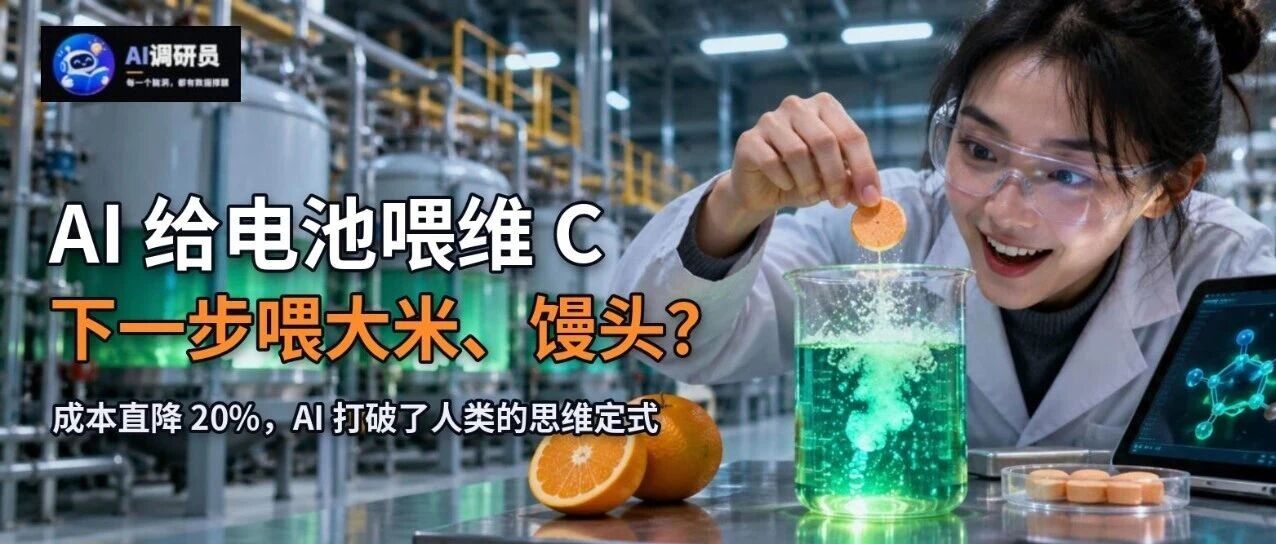
An AI agent sifted through hundreds of thousands of substances and put vitamin C at the top of the list for a grid battery's electrolyte. The researchers didn't believe it, until the lab tests came back.
Contents
Late last year, an AI agent at the Shanghai AI Laboratory was asked a narrow question: what could you add to the liquid inside an iron-chromium flow battery to make it work better and cost less? It searched through hundreds of thousands of substances and came back with a short list. Number one was vitamin C.
The two researchers running the project, Gu Qinying of the Shanghai AI Laboratory and Zhou Tianhang of China University of Petroleum (Beijing), say they found it hard to believe. Then they tested it, and it worked. The new electrolyte recipe is now running in grid storage stations in Lankao (Henan) and Huiyang (Guangdong), and in 2026 it won a first-class science and technology award from the Chemical Industry and Engineering Society of China (Shanghai Observer via Eastmoney, 23 Nov 2026).
So if batteries can take vitamins, what do we feed them next? Rice? Steamed buns? Hold that thought, because the answer is stranger than it sounds.
First: what kind of battery takes vitamins?
Not the one in your phone. An iron-chromium flow battery is a grid-scale battery built for storing solar and wind power for many hours.
Instead of solid electrodes that hold the energy, it keeps its energy in two tanks of liquid: one with dissolved iron, one with dissolved chromium. Pumps push both liquids through a “stack”, where the iron and chromium ions swap electrons. Charging pushes the ions one way; discharging lets them come back. Want to store more energy? Use bigger tanks (MIT Climate Portal).
flowchart LR
  A["Tank: iron solution (Fe²⁺ / Fe³⁺)"] -- "pump" --> S["Stack: ions swap electrons<br/>across a membrane"]
  B["Tank: chromium solution (Cr²⁺ / Cr³⁺)"] -- "pump" --> S
  S --> A
  S --> B
  S <--> G["Grid: charge from solar and wind,<br/>discharge at night"]
Iron and chromium are cheap and the liquid is water-based, so it won’t catch fire. The catch is that the chemistry is fussy: the dissolved metals have to stay in the right oxidation state (how many electrons each ion is carrying), and the reactions at the electrode surfaces need to stay fast and clean, across hot summers and cold winters.
Why vitamin C, of all things?
Vitamin C is famous for one property: it’s an antioxidant. It gives up electrons easily, which is why food makers add it to stop things going brown.
According to the team, that’s exactly what the battery needed:
- It keeps the metals in line. Vitamin C’s antioxidant power stabilises the oxidation state of the active ions in the electrolyte.
- It tidies up the electrode surface. Its oxygen-containing groups take part in the processes at the electrode interface.
- Result: the battery keeps performing well across a wider temperature range (Eastmoney).
After several rounds of “ask the AI, test in the lab”, the team settled on a recipe: how much vitamin C, the iron-to-chromium ratio and the other ingredients. Their industrial partner, Zhonghai Energy Storage (中海储能), scaled it up to full stacks. The reported numbers from the deployed stations:
| What changed | Result |
|---|---|
| Storage capacity | +5% |
| Stack energy efficiency | +3.5% |
| Cost | −20% |
A 20% cost cut is the headline. Long-duration storage only gets built when it is cheap enough, so cost is what decides how much solar and wind power the grid can actually use.
The real story: AI didn’t know vitamin C was “weird”
Here’s the part worth remembering. A battery chemist would probably never have tried vitamin C. It belongs in orange juice, not in a power station. “We researchers often go round in circles inside what we already know,” Zhou said. “AI widened the boundary of what we explore.”
The AI agent, called Shusheng·Nenggong (书生·能工), didn’t have that bias. It linked molecular properties, mechanisms and experimental evidence scattered across the scientific literature, matched them to what the battery needed, and ranked candidates. It has no idea that vitamin C is “a food thing”. It only saw a molecule with the right properties.
That’s a pattern we keep seeing:
- A molecule that brings “dead” batteries back. In February 2025, a Fudan University team led by Peng Huisheng and Gao Yue published in Nature a lithium-carrying molecule that their machine-learning search had recommended. Injected into worn-out lithium-ion cells, it tops up the lithium they have lost. The team projects lifespans far beyond today’s batteries, but that is a projection, and packs would need to be designed for injection (Scientific American; People’s Daily).
- 32 million candidates, one new electrolyte. In January 2024, Microsoft and the US Pacific Northwest National Laboratory used AI and supercomputing to screen more than 32 million candidate materials. PNNL built a working solid-state battery from the winner, a material that uses up to about 70% less lithium. It still needs more optimisation (Microsoft Azure Quantum blog; PNNL).
- A forgotten diabetes compound that kills superbugs. In 2020, MIT researchers trained a model to spot antibacterial molecules. It flagged halicin, a compound once studied as a diabetes drug, which killed many drug-resistant bacteria in lab tests and cleared infections in mice (MIT News).
The common thread: the AI looks at a molecule’s properties, not its reputation. “That’s a vitamin” or “that’s a diabetes drug” doesn’t stop it.
So… can we feed batteries rice?
Sort of, and it’s already happening. You just have to cook it first, at around 1,300 °C.
Sodium-ion batteries, the cheaper cousins of lithium-ion batteries, need an anode made of hard carbon. Scientists make hard carbon by baking plant material until only a disordered carbon skeleton is left, full of tiny gaps where sodium ions can park. The starting material can be:
- starch, the main thing in rice and steamed buns. A 2025 RSC Advances study made a starch-based hard carbon anode that kept 87% of its capacity after 100 cycles (RSC Advances);
- rice husks, the leftover shells from milling rice. Husk carbon baked at 1,300 °C delivered 372 mAh per gram in a 2018 study (FAO AGRIS record).
So “battery eats rice” is not a joke headline. Feeding a lithium-ion battery a bowl of rice would only make a mess. But burnt rice husks, very carefully burnt, can end up inside a sodium-ion battery.
Synthesis (ours, not the researchers’): the next “weird” ingredient may well come from an AI that has never eaten anything and has no idea that some ingredients belong in the kitchen. Its candidates will still need real experiments before anyone believes them. In the vitamin C story, the AI suggested and the lab confirmed.
What this means for you
- Cheaper storage means cleaner power at night. Most of us will never see an iron-chromium battery. What we will see is more solar and wind power on the grid when the sun isn’t shining.
- AI in science is mostly a search engine with taste. It proposes; humans test. “AI discovered X” in a headline usually means “AI made the shortlist, and scientists proved it.”
- Be sceptical of the hype in both directions. Not every AI-suggested molecule works. But when one does, and it’s running in real power stations with a 20% cost cut, that’s not hype.
Sources
- Shanghai Observer (上观新闻), reprinted by Eastmoney, 23 Nov 2026: AI proposes adding vitamin C to batteries, helping Chinese scientists achieve a breakthrough
- MIT Climate Portal: Flow batteries for grid-scale energy storage
- Scientific American: AI found a ‘magic potion’ that can bring dead batteries back to life; People’s Daily: Chinese researchers develop ‘precision treatment’ for lithium-ion batteries
- Microsoft Azure Quantum blog, 9 Jan 2024: How Microsoft’s AI screened over 32 million candidates to find a better battery; PNNL
- MIT News, 20 Feb 2020: Artificial intelligence yields new antibiotic
- RSC Advances, 2025: Starch-derived hard carbon anode for sodium-ion batteries; FAO AGRIS: Rice husk-derived hard carbons as anode materials for sodium-ion batteries
Terms in this article
Related

AI handed in its answer, and humans can't read it! Terence Tao won't sign off yet: a 17-million-line proof, and mathematicians reduced to AI's “exam markers”?
Two days ago we wrote about “AI proving the Riemann Hypothesis that has troubled humanity for 167 years”. Here’s the follow-up: Terence Tao, one of the most famous mathematicians alive, has spoken up, but he didn’t give it the nod.

Tesla's in-car screen “paints” the whole world in real time: Musk explains how it works himself, and the pressure is on Li Bin and Richard Yu
These past couple of days, one trending hashtag set both the car world and the AI world alight: #Tesla in-car compute builds AI models in real time#.

AI “proves” the Riemann Hypothesis that has troubled humanity for 167 years, and even its author can't follow it: 3 ways this affects you
These past couple of days, the maths world and the tech world both exploded. On 20 November, Anthropic mathematician Levent Alpöge announced that, with help from the AI model Claude, he had found a proof of the Riemann Hypothesis.
Comments
Loading comments…