 Add to Home Screen
Tesla's in-car screen “paints” the whole world in real time: Musk explains how it works himself, and the pressure is on Li Bin and Richard Yu
These past couple of days, one trending hashtag set both the car world and the AI world alight: #Tesla in-car compute builds AI models in real time#.

Contents
These past couple of days, one trending hashtag set both the car world and the AI world alight: #Tesla in-car compute builds AI models in real time#.

On 21 November, Tesla began pushing FSD v15 (Supervised) to its first batch of owners. The jaw-dropping part wasn’t that the car drives more smoothly. It was the centre screen: the entire street around your car turned into a 3D scene as realistic as a GTA game.
But it isn’t made by a game engine. The car’s AI watches the camera feeds and “paints” it frame by frame. Even more outrageous, Musk says the job uses only half the compute of one accelerator in the car’s chip.
Plenty of bloggers’ first reaction was “Musk is bragging again”, until they watched videos filmed by American owners and changed their tune. Today, in plain language, we explain 3 things: what it actually is, how a world model works, and what it has to do with you.
1. What actually happened

The new feature is called Reality View. Previously, the road scene on a Tesla screen was built in two steps: the perception system first recognised “that’s a car, that’s a person”, then a graphics program assembled the scene from ready-made 3D models, a bit like building with blocks.
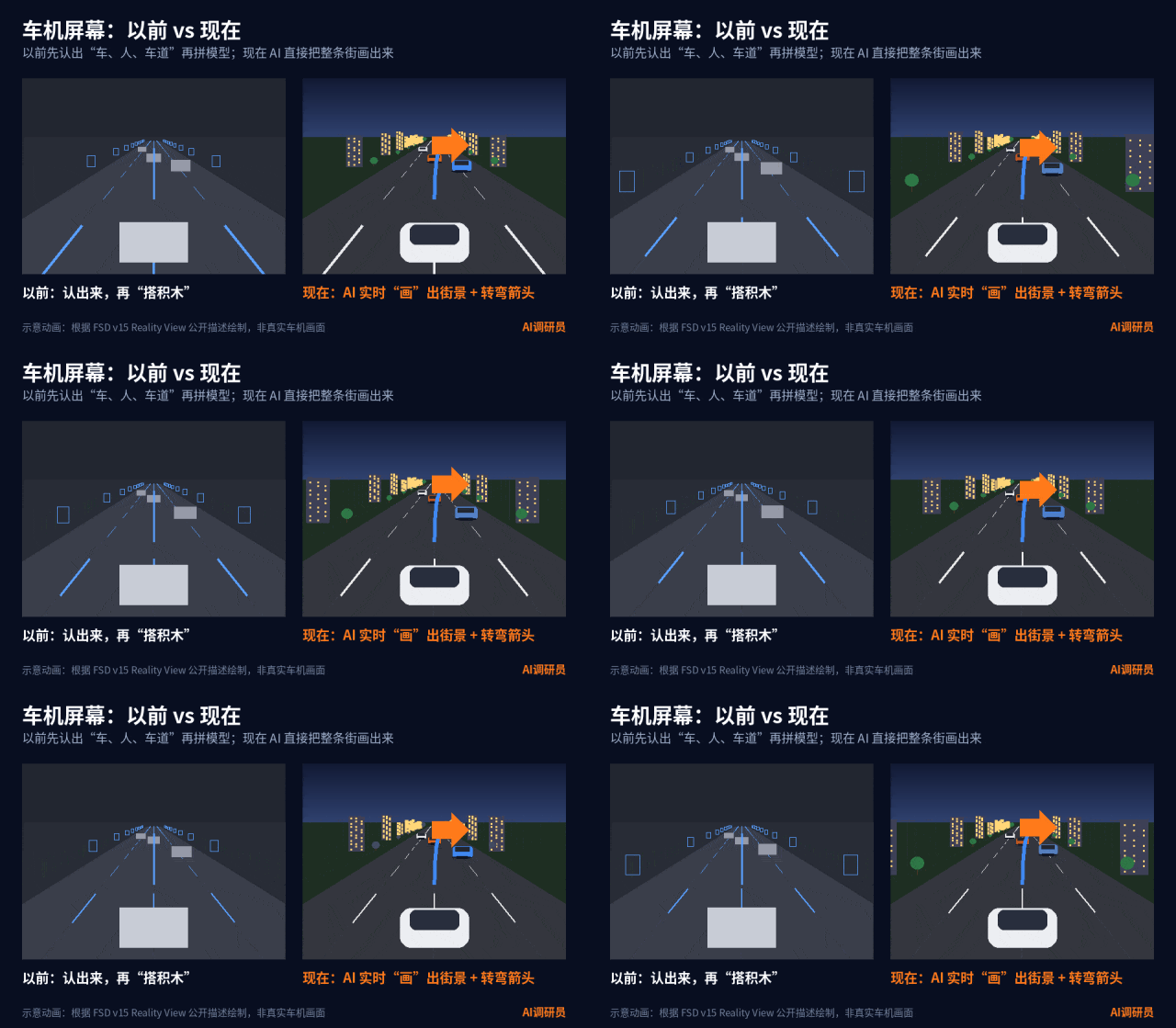
Now there are no more blocks. The AI looks directly at the feeds from the car’s 8 cameras and repaints the whole street in real time from the angle of a “virtual camera” above the roof, painting in the turn arrows and where it plans to stop as well. Bloggers have found that it reproduces the lights on roadside Christmas trees and road signs; tap anywhere on the screen and the car can drive there.
Tesla’s VP of AI software put it more bluntly: it’s “pixels in, pixels out”, generated end to end. In other words: what’s painted on the screen is the world as the AI sees it.
Want to see it for real? Demo videos have flooded X; the links are in “Sources” at the end of this article. Copy them into your browser to watch.
2. The principle as Musk explained it, translated into plain English
Musk posted a few very technical lines on X. Let’s translate them one by one:
① Since last year, Tesla has had an “almost pixel-perfect” world model, used mainly to generate training data in bulk.
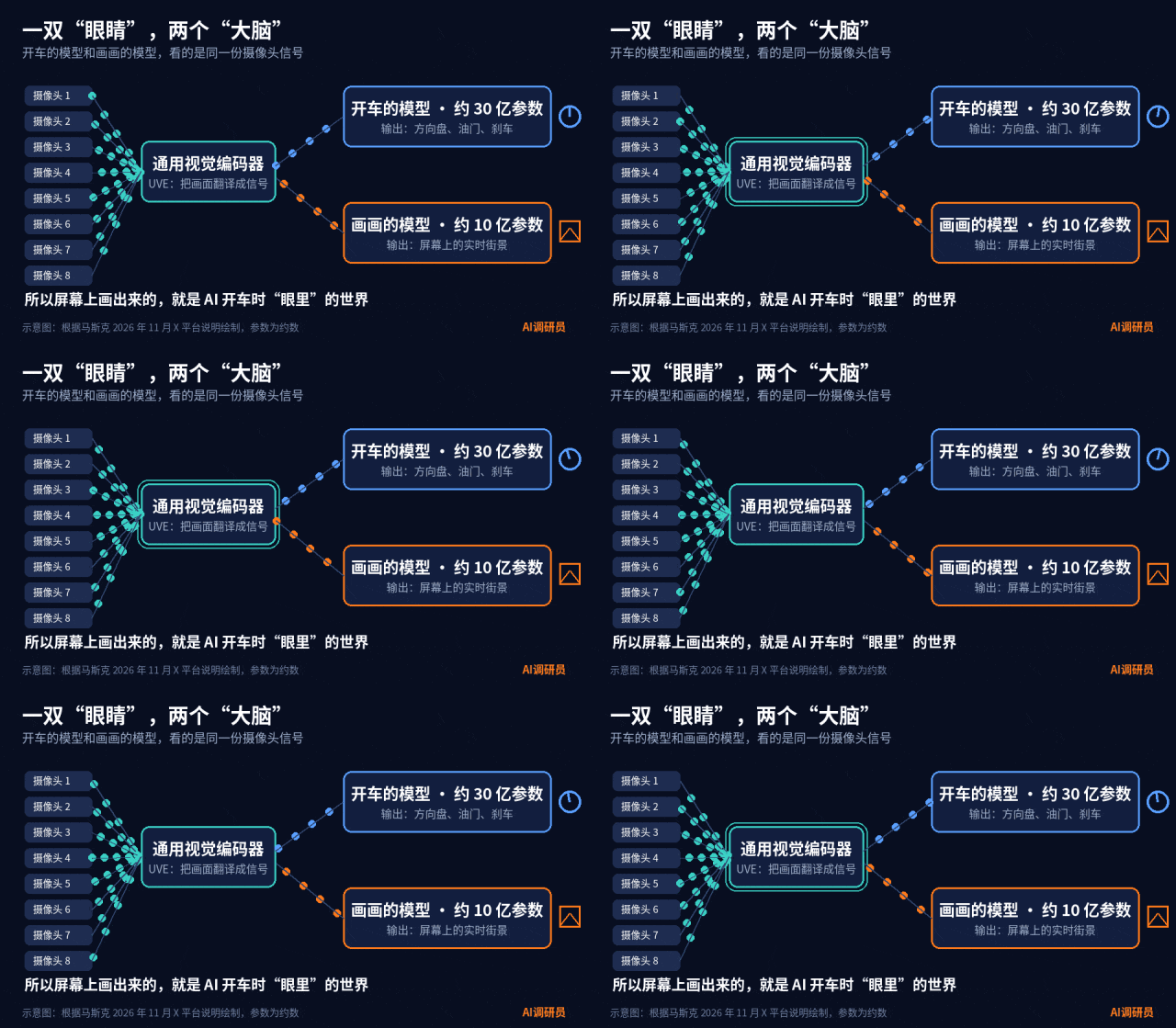
② What runs in the car is its “smaller version”: about 1 billion parameters, sharing the same pair of “eyes”, the Universal Vision Encoder (UVE), with the roughly 3-billion-parameter model that does the driving.
③ Its painting method is called a diffusion model: take the previous frame, add a little “noise”, then wipe it clean to get the current frame.
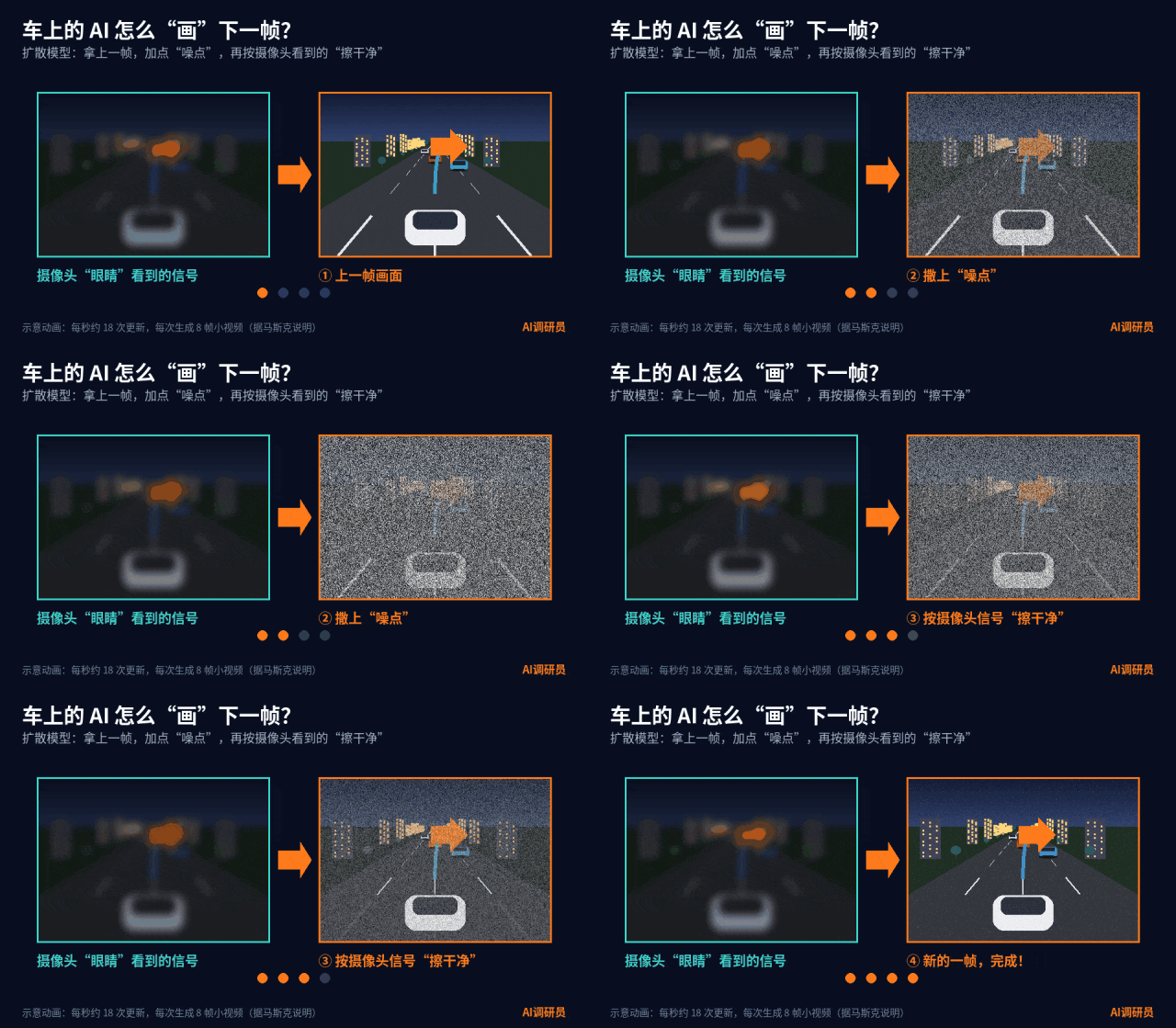
④ Each pass generates a short 8-frame clip at 36 frames per second, the “eyes” update 18 times per second, and it takes up only half a TRIP accelerator.

Musk also admits that the image latency is still on the high side, held back mainly by compute, and the next step is to cut latency by about another 35%. He also said cars will stay on the current AI4 chip, while the next-generation AI5 goes first to the Optimus robot.
3. So what is a world model?
An analogy: when you’re driving and see a football roll into the road, you slow down without thinking, because you know a child might dash out after it. You carry a set of common sense about “how the world works” in your head. That’s a world model.
An AI world model does the same thing: after watching huge amounts of real driving video, it learns “what happens next”. Give it the current scene and an action, such as braking, and it can work out what the world will look like a second later.

Last year Tesla showed off a “world simulator”: it can generate driving footage from 8 cameras at once, at 24 frames per second, for over 6 minutes, and a person can steer and brake inside it in real time. Engineers use it to replay accidents from a year earlier and see whether the new AI makes the same mistake again; they also deliberately create extreme situations like “a car suddenly cutting in alongside” to test the AI. It reportedly learns the equivalent of 500 years of human driving experience in a single day.
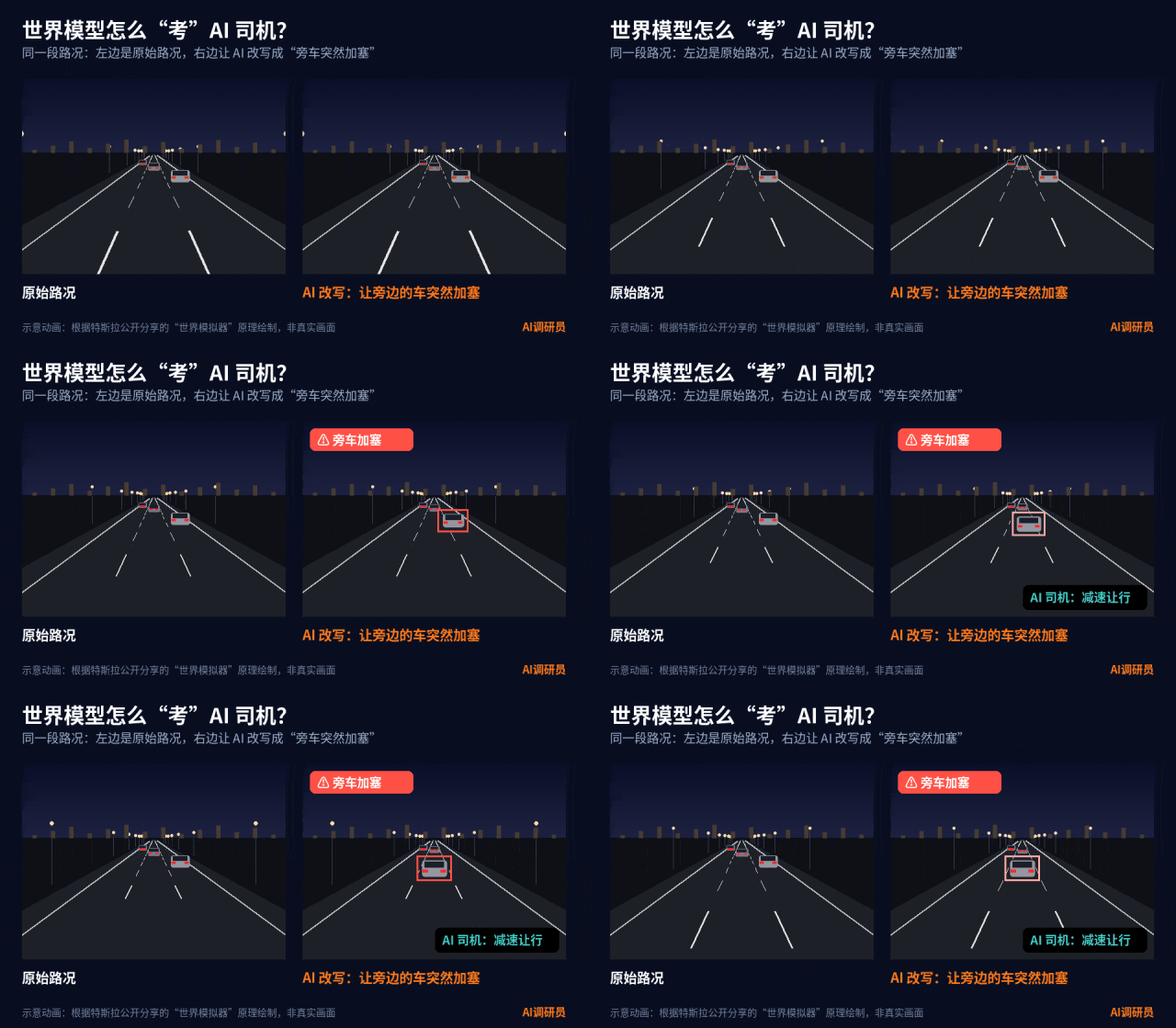
Reality View takes this “world-building” ability, shrinks it, and fits it into your car.
4. “Whatever Tesla has, we have too”? Who’s feeling the pressure
At this point, netizens immediately recalled two famous lines.
The first is something NIO’s Li Bin (李斌) said years ago: “Whatever Tesla has, we have too; what we have, Tesla doesn’t.” Last month, when Tesla demoed the Roadster “flying”, Li Bin already graciously admitted once: “This one we really don’t have.” With the in-car screen now painting the world in real time, people in the comments are asking again: Mr Li, do you have this one?
The second is Huawei’s Richard Yu (余承东) and his “far, far ahead” (遥遥领先). One netizen counted that at the Huawei Mate 40 launch, he said it 14 times in one event. This time netizens joked: can the in-car system that’s “far, far ahead” also paint us a world in real time?
To be fair, though: Chinese carmakers haven’t been absent from the world-model race. NIO released its NWM world model back in 2024 and pushed it to more than 700,000 users this June, letting the model directly output steering, throttle and braking; Huawei Qiankun (乾崑) also has its WEWA world behaviour model.

The real difference: this time Tesla painted the “world inside the AI’s head” directly for owners to see, and the visual impact is huge. As for whose world model drives better, that comes down to takeover rates and accident data on real roads, not whose screen looks nicer. Some bloggers have poured cold water on it too: the visuals are cool, but whether they improve smart-driving performance remains a question mark.
5. What does this have to do with ordinary people?

1. The screen has become the AI’s “eyes”. Before, you couldn’t tell what smart driving actually saw. Now what the AI sees and how it plans to drive are painted right in front of you, so you have something to judge its reliability by at a glance.
2. Older cars may miss out. FSD v15 is only for HW4/AI4 models; older HW3 cars top out at v14 Lite. When buying a smart car in future, “how much longer can the chip keep getting upgrades” will matter more and more.
3. However realistic the picture, it’s still “Supervised”. FSD’s full name is FSD (Supervised): the driver must be ready to take over at any time, and if something goes wrong, the responsibility still lies with the person driving. Just a few days ago, Richard Yu’s remark that “you can sleep while driving” was slammed all over the trending lists, so here’s another reminder: however cool the picture, keep your hands on the wheel.
Also, FSD v15 is rolling out first in the US. There’s no official word yet on when it will be available in mainland China.
Final thoughts
In one sentence: what Tesla showed off this time isn’t just a pretty picture. It’s that AI can now “imagine” the entire world in real time, inside your car.
Would you rather have a car that “paints the world”, or a car that “makes you take over less”? Let’s talk in the comments.
Sources
Cern Basher (X): explainer on Tesla Reality View; FSD v15 began rolling out on 21 November: https://x.com/CernBasher/status/2124318004586357039
Demo video (X, Bilawal Sidhu): Reality View filmed live: https://x.com/bilawalsidhu/status/2124323235063816204
eletric-vehicles.com: Musk on Reality View and AI4/AI5: https://eletric-vehicles.com/tesla/tesla-cars-to-stay-on-ai4-chip-as-ai5-goes-to-optimus-musk-says/
The Tesla Newswire (X): plain-language version of Musk’s explanation: https://x.com/TeslaNewswire/status/2124502660670009468
Ming (X): Musk’s own words and a mean-flow explainer: https://x.com/tslaming/status/2124474912161087636
Sina Weibo: Musk reveals Tesla generates a pixel-level world model in the car in real time: https://www.sina.cn/weibo/detail/5368135263981623.html
Sina Weibo: technical analysis of FSD v15 in-car AI modelling: https://www.sina.cn/weibo/detail/5368035108192280.html
Sina Weibo: FSD v15 is HW4-only; release-note highlights: https://www.sina.cn/weibo/detail/5368042474963257.html
Sina Weibo: a blogger questions whether real-time modelling improves smart driving: https://www.sina.cn/weibo/detail/5368043603757497.html
Wallstreetcn (华尔街见闻): Tesla’s “world simulator” learns 500 years of human driving experience in 1 day: https://wallstreetcn.com/articles/3757967
Thread Reader: Tesla’s AI chief shares key points on the world simulator: https://threadreaderapp.com/thread/1982161471644545387
Not a Tesla App: FSD v15 supports HW4 only: https://www.notateslaapp.com/news/4679/tesla-ai-chief-talks-about-whats-coming-in-fsd-v15
Yicai (第一财经): NIO’s Li Bin on Tesla’s flying car: “This one we really don’t have”: https://www.yicai.com/news/103397005.html
Beijing Business Today (北京商报): Richard Yu said “far, far ahead” 14 times at the Mate 40 launch: https://www.bbtnews.com.cn/2023/0926/490488.shtml
Huxiu (虎嗅): big companies’ world-model strategies; NIO’s NWM: https://www.huxiu.com/article/4870176.html
Tencent News: everyone’s talking about world models; what each company’s technology focuses on: https://news.qq.com/rain/a/20260803A02POC00
Image: Unsplash (Unsplash License): https://unsplash.com/photos/a-person-driving-a-car-with-a-computer-on-the-dashboard-pDOM_D1GEwk
Image: Unsplash (Unsplash License): https://unsplash.com/photos/person-driving-car-during-night-time--UAmLjpbFis
Image: Unsplash (Unsplash License): https://unsplash.com/photos/person-holding-car-steering-wheel-NYFUVvKYAdI
This article is only an explainer of tech news and does not constitute driving or car-buying advice. When using assisted driving, follow local regulations and stay attentive throughout. The animations and infographics in this article are original illustrations drawn by us from public information, not real in-car screens.
Terms in this article
Related

AI told scientists to give a battery vitamin C. It worked. Is rice next?
An AI agent sifted through hundreds of thousands of substances and put vitamin C at the top of the list for a grid battery’s electrolyte. The researchers didn’t believe it, until the lab tests came back.

AI handed in its answer, and humans can't read it! Terence Tao won't sign off yet: a 17-million-line proof, and mathematicians reduced to AI's “exam markers”?
Two days ago we wrote about “AI proving the Riemann Hypothesis that has troubled humanity for 167 years”. Here’s the follow-up: Terence Tao, one of the most famous mathematicians alive, has spoken up, but he didn’t give it the nod.

AI “proves” the Riemann Hypothesis that has troubled humanity for 167 years, and even its author can't follow it: 3 ways this affects you
These past couple of days, the maths world and the tech world both exploded. On 20 November, Anthropic mathematician Levent Alpöge announced that, with help from the AI model Claude, he had found a proof of the Riemann Hypothesis.
Comments
Loading comments…